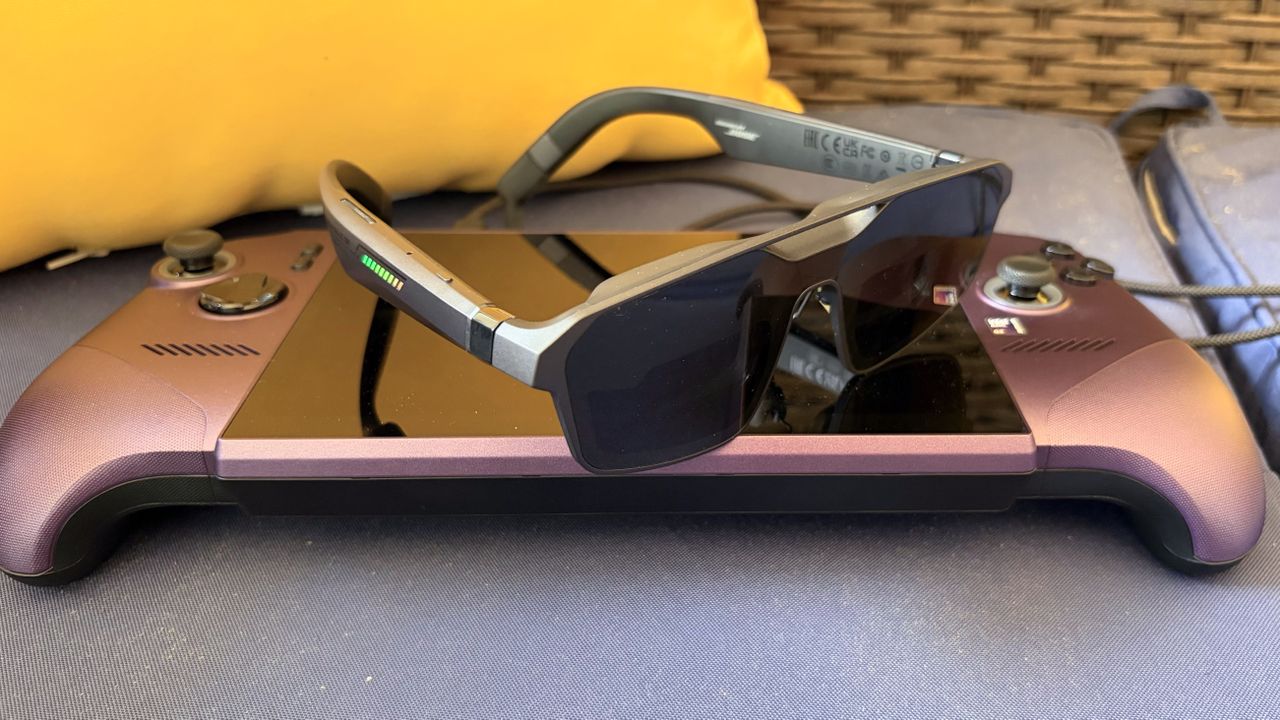
Over the past several years, I’ve reviewed a growing number of augmented reality (AR) glasses. For the most part, these shades share the same mission: to give consumers a way to enjoy video content and even work on productivity tasks with a Mac or Windows device via a 150-inch (ish) virtual screen. Most of these glasses top out at a 120 Hz refresh rate and weren’t designed specifically for a gaming audience (though many can be used for gaming). That is changing with the Asus ROG Xreal R1, which is a collaborative effort from two big names in tech. Not only does the R1 boost the maximum refresh rate to 240 Hz to appease hardcore gamers, but it also serves as a breakout box for gaming on your PC, Xbox, PlayStation, or Switch. The R1 promises and delivers a lot, but it comes at an even higher price than Asus’ AirVision M1 , which debuted at $700 two years ago. Design of the Asus ROG Xreal R1 Although it shares many of the same internals as the Xreal One Series AR glasses, the R1 has an unmistakable ROG flair. Whereas the “One” glasses have smooth surfaces and rounded edges, the R1 has a more angular design and chamfers along the temples. And in keeping with ROG design ethos, there is a line of 9 LEDs along both temples, along with Republic of Gamers etchings. The glasses are constructed from high-quality plastic, which feels similar to that of the Xreal One and One Pro . But whereas the Xreal glasses have a soft, matte finish, the R1 has a shimmering grey finish. Unlike the One glasses, the R1 doesn’t have a detachable front frame, which probably isn’t too much of a hindrance, as the glasses already have a clean, modern aesthetic when viewed from the front. Tom's Hardware Tom's Hardware Tom's Hardware The R1 features open-air speakers along the temples, with a USB-C port at the rear of the left temple. The top of the right temple features a programmable Quick button. On the underside of the right temples, you’ll find a menu button and a rocker switch that navigates thr
تقنية
Asus ROG Xreal R1 Review: Gaming-focused AR glasses deliver 240 Hz performance and RGB style